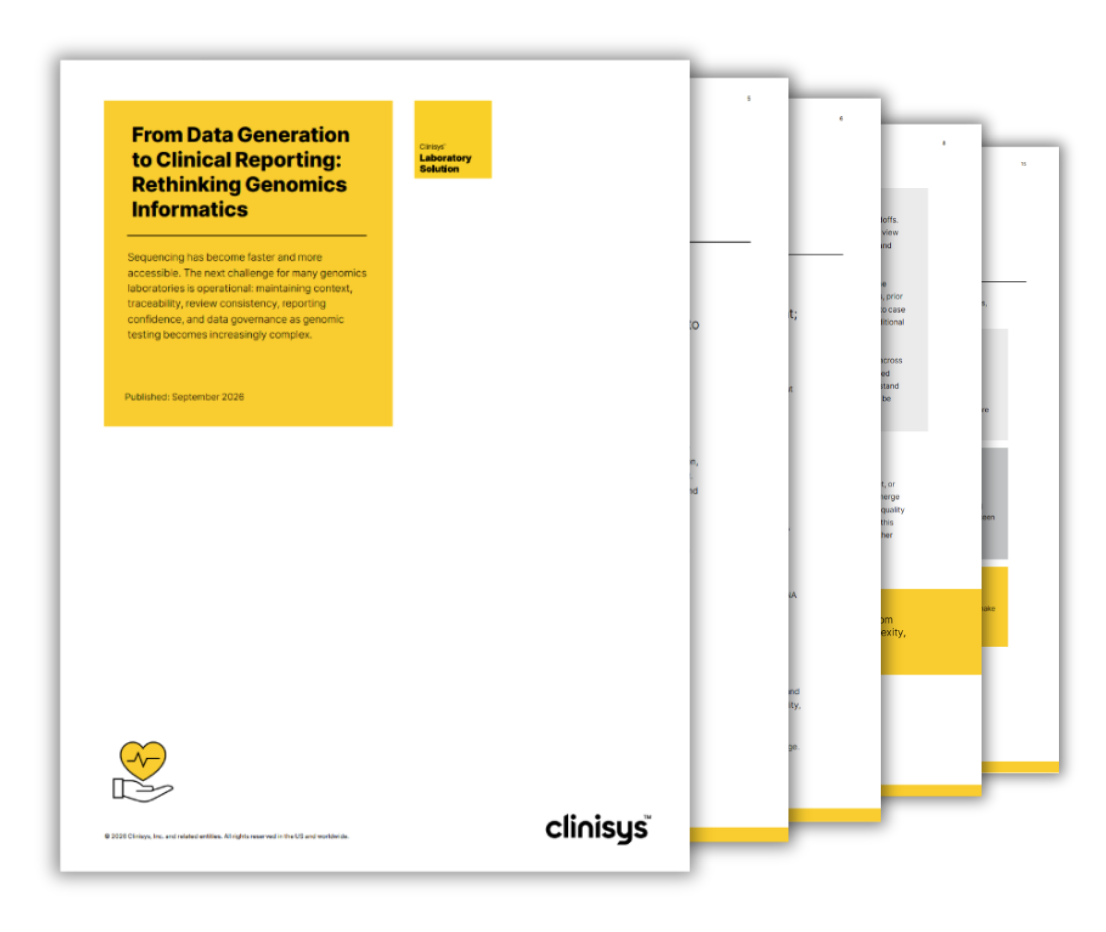
From Data Generation to Clinical Reporting: Rethinking Genomics Informatics Whitepaper
Genomics laboratories have made significant advances in sequencing capacity, assay diversity, and data generation. Yet as precision medicine programs expand and clinical, translational, and high-throughput genomics workflows become more complex, many laboratories are finding that the most pressing constraints now sit downstream of sequencing.
The challenge is increasingly operational: how to preserve sample context, metadata continuity, workflow visibility, interpretation history, quality documentation, and reporting inputs as volumes grow and testing models evolve. When these foundations are fragmented across systems, spreadsheets, manual handoffs, or disconnected tools, laboratories can face avoidable rework, delayed reviews, inconsistent documentation, and added pressure on specialist teams.
The laboratories best positioned to scale genomics are not necessarily those generating the most data, but those able to maintain operational control as complexity grows. Achieving this requires more than workflow automation. It requires a connected genomics operational backbone that links samples, workflows, data, quality processes, interpretation activity, analytics, and reporting inputs across the testing lifecycle.
This whitepaper examines operational bottlenecks that can emerge in modern genomics laboratories and presents practical principles for building a stronger genomics operational backbone. It is written for genomics laboratory leaders responsible for scaling clinical, translational, precision medicine, and high-throughput operations where consistency, traceability, turnaround time, and reporting confidence directly affect laboratory performance
Download the full whitepaper to continue reading.